


Story by DDNS Reporters Gracie Lunceford and Kinley Rainwater
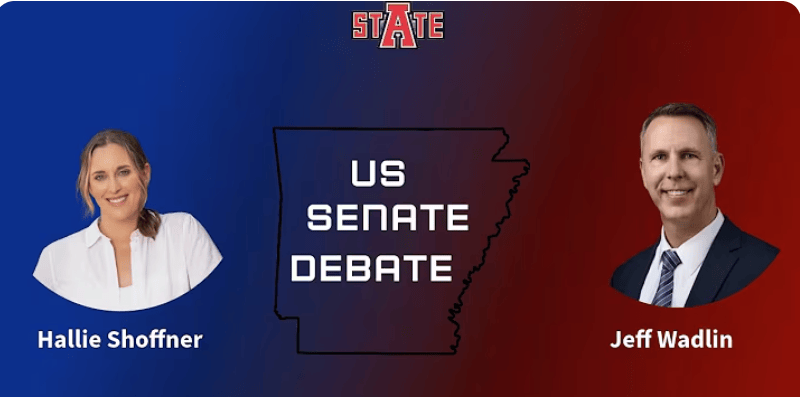
In the third and final political debate at ASUTV, Democratic candidate Hallie Shoffner and Libertarian candidate Jeff Wadlin faced off for Arkansas’s Senate seat. Republican incumbent Tom Cotton was invited to join, but did not respond.
Marty Scarbrough moderated the event, with panelists Johnathan Reaves, Lexi Burns, Allie Carson, and Levi Seward.
Hallie Shoffner began the opening-statement segment by sharing her family’s long history of farming in Arkansas.
“I am a sixth-generation farmer. I am the daughter of farmers. I am a wife, a mom, and a caregiver, and I am running to put Arkansas first.”
Shoffner touched on incumbent Tom Cotton’s choices during his time in the Senate, including voting against the farm bill twice, shutting down 25% of family farming operations in Arkansas— including her own.
“I am here because last year I had to close my family’s 150-year-old farm because of the farm crisis. I have lived the rising costs, I have lived the broken system, and I decided I wouldn’t surrender.”
She says showing up for Arkansans is her main commitment every day, not just for the duration of election season.
“If I can’t farm, I’m going to fight for Arkansas. I’m going to fight for you.”
Jeff Wadlin, running as a Libertarian candidate, started his opening statement by establishing his career as an engineer and businessman, working for large corporations such as Sam’s Club and Capital One, and building his own businesses.
“My expertise is in solving complex problems, which is exactly what Washington, DC needs.”
His top concerns included lowering inflation, encouraging economic development, fixing Social Security, and ending foreign wars. Diverting from the two-party system that dominates US government, he wants to give citizens a third option.
“A true pragmatic centrist who’s only interested in solving problems to make everyone healthier and wealthier regardless of where you are on the political spectrum.”
Regarding the absentee incumbent, Wadlin disagrees with Cotton’s choices to support foreign wars at Arkansas taxpayers’ expense.
“He’s happy to take a million dollars from APAC to buy an election, to be an ambassador for Israel, instead of being an ambassador for Arkansas.”
On the panel first was Johnathan Reaves, an instructor of Mass Communications at Arkansas State University and faculty advisor of Delta Digital News Service. After the 76-day partial government shutdown of 2026, Reaves raised a two-part question for Shoffner: “How do you propose that we do not go through government shutdowns again? And second, what are your thoughts on lawmakers getting paid when federal employees are not?”
Shoffner starts with the second part of the question, affirming that she would not accept a salary during government shutdowns.
“I do not believe that if the government is not working, in the same way if an Arkansans does not go to work, we should also not be paid.”
Regarding the first portion of the question, Shoffner says she’s seen citizens across the state feel neglected by Congress. She attributes this to elected officials being more “extreme” than many Arkansans.
“All of us live somewhere in the middle. Look no further than the fact that the last two Congresses have been two of the most unproductive in history…If a government shutdown does occur, I will not take a salary, but I will do everything in my power to ensure that doesn’t happen to the detriment of the people in Arkansas.”
Wadlin attributed these long government shutdowns to conflict between the democratic and republican parties, which leads to other issues such as Social Security going bankrupt and a struggling healthcare system.
“These sorts of things are not acceptable,” Wadlin states. “And certainly, the legislators should not be paid when there is a government shutdown.”
He mentioned that select legislators believe that their yearly salaries of $174,000 aren’t enough, and encourages those who are concerned about making money to pursue other high-paying careers.
“That’s pretty insulting to the average Arkansan who makes 50-60 thousand dollars a year… if they’re so worried about making money, they can vote their conscience, risk being primaried, or risk being voted out, and go be an attorney or a lobbyist, and go make more money.”
In her retort, Shoffner returns to why the shutdown first occurred: disagreement over the Department of Homeland Security. This shutdown unintentionally affected Supplemental Nutrition Assistance Program (SNAP) benefits, which many rely on to afford groceries. This financial stress affected many Arkansans. Shoffner affirms that, if elected, she would continue traveling between Washington, D.C., and Arkansas to better understand and communicate with citizens about their specific community needs.
“You can only legislate well for the people you represent if you include them in the conversation and give them a seat at the table.”
Reaves asked his second question to Wadlin: “If you were elected, at the end of your first term, what measurable accomplishments should Arkansas voters use to judge whether you’ve earned re-election?”
Wadlin says his main concerns are economic issues that affect everyone, like a balanced-budget amendment and reducing the trillions of dollars in debt.
“I will seek placements on committees like the finance committee, where we need to work on not just balancing the budget, but also bringing the debt down. We need to reduce our deficits. We can’t keep running up these trillions of dollars of debt.”
Additionally, he wants to fund Social Security for senior citizens, make it more lucrative for young people in the long term, and help repair the healthcare system to ensure people across Arkansas have access to affordable healthcare.
In Shoffner’s response to the same question, if elected, she also aims to support the healthcare system by strengthening rural hospitals and protecting Medicaid and Medicare for senior citizens. Veterans are also at the top of her list of priorities.
“The story I hear across Arkansas is too often, they have to fight their own government to get the benefits they have earned.”
Foreign wars and the money spent are also major concerns for her, as is a sustainable food system that would help end the farming crisis and provide neutral, homegrown food for families and schoolchildren alike.
Shoffner says, “I know that is a long list for someone to want to fight for, but this is Arkansas. We have problems, and it’s time for us to have a representative that not only acknowledges and understands those problems, but is willing to fight tooth and nail every single day to solve those issues.”
Wadlin agrees with the sentiment about foreign wars, noting that despite the large sums of money, nothing is changing, and saying, “We need to not be involved in these foreign wars of aggression.”
Lexie Burns, a reporter and co-producer for KASU’s Morning Edition, asked Wadlin about Arkansas’s high maternal mortality rates, with Northeast Arkansas having the highest rate in the state: 16.3 events per 10,000 births. Seeing as Arkansas is the only state in the US not to expand postpartum Medicaid coverage from 60 days to 12 months, Burns asked, “Is expanded Medicaid postpartum coverage something you support? And how would you work with your colleagues to strengthen and increase access to prenatal care during pregnancy and postpartum healthcare?”
Wadlin shared support for expanding postpartum Medicaid coverage and his distaste for the current state of medical insurance in the state.
“Arkansas definitely needs to have 12 months of postpartum care. That’s unacceptable that we were the only state not to do that.”
Wadlin says not everybody is covered by insurance because healthcare is so expensive in the country. He says this cost is most definitely able to be cut.
With lower healthcare costs, Wadlin says everyone would be able to get health insurance, which would in turn help mothers and babies.
The rural healthcare crisis came forward as a harm to maternal health when Wadlin explained the lack of access to emergency and labor and delivery services. He says the fix is to ensure there’s labor and delivery and emergency services within 30 minutes, primary care within 60 minutes, and specialty care within 90 minutes.
While Wadlin says these things are sure to help maternal healthcare, economic development is important to solving these issues. He says wealth helps not only with healthcare, but also with nutrition and crime rates that “make our communities more violent.”
Shoffner supports expanding coverage to 12 months of postpartum care, but she says that’s only part of the problem.
“To be perfectly honest, our healthcare system as a whole is incredibly flawed. And the reason is that too few companies control the entire system.”
Shoffner says the simplest way to change that is to make sure everyone has access to affordable health insurance. She says this can strengthen rural hospitals, and when it does, they will better understand what the community needs, ensuring residents who work there can also live there and give the hospitals a community to serve.
Another important aspect Shoffner emphasizes is ensuring that preventative care, prenatal care, and postnatal care are all covered.
Agriculture remains Arkansas’s biggest industry, generating $ 20 billion annually; despite this, food insecurity in Arkansas remains a troubling and prominent issue. In 2018, Congress extended the Farm Bill three times to fund major programs like SNAP. In September of this year, the bill expired, and no new bill has replaced it.
Burns asked, “Given that Arkansas desperately needs both agriculture protection and nutrition funding, where would you compromise? And, if elected, where would your priorities lie?”
Shoffner began, “I have long been trying to understand the relationship between the fact that our largest industry is agriculture and yet we are the hungriest state in the country.”
She points out that we need an entirely new farm bill and, additionally, a food bill to strengthen the relationship between farmers and their communities. Allowing farmers to sell their crops directly back into their communities provides fresher, healthier food for citizens and is also lucrative for farmers.
“Not only are we growing food that we’re feeding back into the communities in which it is grown, but we are also rebuilding rural economies step by step with a brand new kind of farm bill.”
In Wadlin’s response, he credits the stagnant farm bill to another issue Republicans and Democrats are gridlocked on.
“It’s been years since a farm bill has been passed. And of course, we need to pass a more current farm bill as soon as possible. And this is just another example of… where Republicans and Democrats working together are giving us terrible outcomes.”
He explains how the government can affect farming businesses both directly and indirectly, through high tariffs, rising diesel prices, and “trapping” farmers in low-margin commodity crops.
Shoffner reinforced her support for Arkansas agriculture and her eagerness to put new farming initiatives into place.
“This is an idea that could truly remake the face of Arkansas’s economy and our health and our well-being.”
Allie Carson, an aspiring multimedia journalist and student, raised concerns in agriculture for newly emerging professionals out of college.
“What specific steps would you take in the Senate to help farmers remain comfortable, support that next generation of agriculture professionals, and to prevent trade policies from further hurting Arkansas?”
Shoffner says the first step is ending the war in Iran. She says incumbent Tom Cotton wants this war and refuses to end it, however.
“To be clear, this is the war that Tom Cotton has wanted in the last 14 years. He finally got it, and we are paying the price. And some of the folks paying the price are not just families at the gas station. It’s also farmers who are buying fertilizer; they’re buying diesel.”
Beyond the Iran war, Shoffner says the second step is to end the “chaotic” trade war. She explains that input costs for farmers and families have skyrocketed not only because of the tariffs, but also because of the retaliations that followed.
That said, Shoffner also points out that tariffs can be useful if used strategically. She says this is especially true for sensitive crops, such as rice.
For her third point, Shoffner returned to her previously mentioned farm, or “food bill.” She says she wants to ensure farmers can diversify into more crops by giving them risk-management tools so they can take risks on other crops and build more infrastructure.
The mass consolidation of farmland in Arkansas is Shoffner’s last concern. She says farmers are going out of business, and when they do, high-net-worth individuals and corporations consolidate the land.
“And that’s dangerous because land is the foundation of our whole system. Now, I am all for folks doing whatever they please with their own property. But we have to consider, at what point does mass land consolidation constitute market manipulation, and constitute human monopoly?”
Shoffner says she wants to keep the land in the hands of active Arkansas farmers, and she believes those four actions can do that.
Wadlin started by reinforcing Shoffner’s ideas, such as passing a farm bill, ending tariffs, and ending the war in Iran. However, he says that alongside those options, we need to stop regulating and subsidizing to ensure farmers can get into crops, livestock, and other profitable industries.
Wadlin also adds that many farming inputs are highly consolidated. He cites Bayer’s 2018 acquisition of Monsanto as an example.
Wadlin feels right-to-repair laws need to change to better support farmers and allow more independence.
“If a farmer buys a tractor or a combine, they should be able to repair that themselves. They should be able to get the manuals for a reasonable price. They should be able to buy their own parts and have their own technician do the repairs. They should not be held captive to large equipment manufacturers.”
Shoffner brought the conversation back to rural communities. She says if a farm bill passes that allows for more infrastructure, that’s great, but these communities still need investment in their schools, hospitals, roads, waterways, sewers, and electrical grids.
“One of the things I’d like to do is set up an office to provide technical assistance for our cities and counties to be able to apply for federal grants to ensure they can build that kind of foundation that they need to build the industry that’s going to provide new jobs, new wages, in communities that right now are struggling.”
Carson’s next question focused on the rising cost of living and the pressure it puts on young adults leaving college.
“What specific federal policy would you support to help college graduates afford to build lives in Arkansas?”
Wadlin says the blame for the rising cost of living is on multiple things, and he never hears his opponents mention debt or the Federal Reserve.
Wadlin says the debt and the Federal Reserve are invisibly driving inflation, which is driving up costs.
Specifically about the debt, Wadlin brings up the Big Beautiful Bill as an example. He says we raised 5 trillion dollars, yet we’re spending 7 trillion dollars, leaving a 2 trillion dollar deficit that adds to the debt, which is now up to 40 trillion dollars. He says government spending money they don’t have is inflationary and will cause a crisis down the road for young adults, since someone has to take on that debt.
Wadlin explained that every time we have a hiccup like the 2008 banking crisis or the 2020 pandemic, the Fed prints more money to try and soften the landing for citizens. He says this is also inflationary and that since 2020, the money supply has risen 50%, which, according to Wadlin, results in a ⅓ paycheck cut for citizens.
“..And so, this is the type of thing that needs to be addressed. The Fed needs stricter monetary policies so they’re not so loose with printing money whenever there’s an economic blip. And those are the things that I’m going to be focused on in the Senate.”
Shoffner says that although they have already talked about building an economy in general, ultimately, when a student graduates, they want a job with a good wage, a home, health insurance, and a vehicle. However, the current situation is making this very difficult, according to Shoffner.
According to Shoffner, she has met many college students who feel that they are doing everything they are supposed to do, but aren’t seeing the benefits. She says this is because a rigged system has failed them and continues to fail them, benefiting the powerful rather than the citizens.
“It’s not because they failed. It’s because the system is rigged against them,” says Shoffner. “And it’s been rigged by and in favor of politicians like Tom Cotton and his biggest donors and his own national political ambitions, instead of the people of Arkansas, instead of young people. That has to change.”
While ending the Iran war and the trade war might lower costs, Shoffner says economic development in places like Jonesboro and continued support for the city as it grows are also important. She points to housing as a concern.
Shoffner says we need more affordable housing, and she suggests more infill housing. She says we need houses that young people can afford to buy.
“Because one of the most important things that you can do is live in the place that you work,” says Shoffner.
Shoffner herself has met too many young adults who have to drive up to an hour to get from their home to their workplace, and she says, “That means they’re just shoving their paycheck into their gas tanks. I want to change that.”
According to Shoffner, affordable housing is within reach. She says it just needs to start with having the conversation with young people and contractors to start getting creative.
“We just need to start having this conversation, and until we have new representation, I don’t think that’s going to happen.”
Wadlin says Social Security reform is on his to-do list. He says the payroll tax that funds Social Security is our most regressive tax and says that the burden falls primarily on the young people.
“That’s 15% right off the top that they’re paying for the healthcare and retirement of their grandparents.”
According to Wadlin, his proposal to expand children’s investment accounts would allow the payroll tax to taper over time. He says this idea would save young people, in particular.
Wadlin also agrees there is room for concern about economic development. He says that is the major difference between a struggling community and a thriving community. Wadlin says his approach is to work with state and local officials to bring more economic development from across the country, or even the world, back to Arkansas.
Levi Seward, a political science and philosophy student and President of Arkansas State University’s Pre-law club, was the final panelist.
“Should domestic lobbying groups that heavily advance a foreign state’s policy goals, such as AIPAC (American Israel Public Affairs Committee), be required to register under FARA (Foreign Agents Registration Act)?” asked Seward.
Wadlin says they should absolutely have to register, and that in general we need to get away from the foreign influence of super PACs such as AIPAC that are aligned with foreign governments.
Wadlin says Citizens v. United needs to be overturned. He says it was wrongly decided and that he will work to get it overturned in the Senate. He says it just needs to be re-litigated.
Technically, there is a $3,500 limit on how much money you can donate to a federal candidate’s campaign. Wadlin says this is due to the quid pro quo because in the court’s eyes, he says they see it as, “You gave me that money and now I owe you a big favor.” He says this remains true of super PACs.
“When AIPAC funds attack ads against Tom Cotton’s opponents, he knows where that money comes from, and he certainly owes them a favor, and he certainly is repaying those favors daily,” says Wadlin.
Shoffner starts by agreeing with Wadlin. She says she supports ensuring anti-corruption laws in our Constitution, reforming campaign financing, and overturning Citizens United.
Shoffner says she wants to take this a step further, however. She says she believes in term limits for Congress and for Supreme Court justices as well as ethics laws. Shoffner says she believes in ending stock trading among cabinet appointees and justices, not just for elected officials.
Shoffner stated if chosen, she will put everything that she and her husband own into a true blind trust. She will not be able to touch those things for as long as she holds the seat.
“…so that the people of Arkansas know that whatever information I hear in any room in the halls of power, I will not be able to use that to enrich myself. I want the people of Arkansas to know that I am going to Washington, D.C., not for myself, not for some political game, or political points. This is all about the people of Arkansas and fighting for them and not Washington insiders.”
On Wadlin’s side, he says he already has his stocks in index funds, so trading individual stocks shouldn’t be a problem for him. However, he agrees that legislators should not trade stocks.
Wadlin mentions political gerrymandering as a major concern. He says that regardless of which side it comes from, it’s bad for democracy. According to Wadlin, neutral boards should make those decisions to ensure fairness and representation for all voters.
Seward notes the incumbents’ lack of attendance and uses it for his next question.
“If he were sitting here right now, what is the single vote or decision of his you’d make him defend? And what answer would you expect from him?”
Shoffner says that she couldn’t possibly think of just one. She says she thinks of the war in Iran, the loss of healthcare, the support of the chaotic trade war. She says it’s because he voted for the one Big Beautiful Bill. Shoffner says it goes beyond just voting for it, though.
“Tom Cotton didn’t just vote for the one Big Beautiful Bill; his name is on the bottom of it,” says Shoffner.
As for his answer, Shoffner says it’s exactly why he didn’t show up. She says he cannot answer for it, whether it’s fear, a lack of care, or both. Shoffner says neither works for Arkansas.
According to Shoffner, after a bad meeting in Springdale 10 years ago, incumbent Cotton stopped holding town hall meetings, and now Arkansas has gone 9 ½ years without a single one.
Wadlin starts off his response by reiterating his feelings on the incumbent.
“As I said in the last debate, Tom Cotton is a coward and a hypocrite for not being here. And there is a long laundry list of things that he’s doing that are terrible for Arkansans.”
In Wadlin’s eyes, a large part of the blame for the Iran war falls on incumbent Cotton.
Cotton was one of the most vocal and prominent opponents of the JCPOA, and Wadlin says he tried to scuttle it while it was being negotiated. When it was ripped up in Trump’s first term, Cotton was in full support but with nothing to replace it, Iran began enriching their uranium again according to Wadlin.
With Cotton often saying, “we need to finish the job militarily,” Wadlin asks what that really means.
“Did we finish the job militarily in Afghanistan? Did we finish the job militarily in Iraq? We need to stop these foreign wars of aggression that are unwinnable.”
Wadlin feels that Cotton is not working for the average Arkansan, but for the powerful and the wealthy.
Some examples of this were given, such as Cotton’s support of the Protect College Sports Act, which Wadlin feels is unfair to college athletes.
“In every decision where Tom Cotton can go left or right, and make a decision for the little guy or the big guy, he’s always going to leave Arkansans in a lurch.”
Shoffner starts her response by saying there’s one thing she can point to that Cotton says he’s done: building the munitions plant in East Camden.
Shoffner admits this created 5000 jobs, but the hospital 15 minutes away is in bankruptcy proceedings and has laid off 40 people. She says Camden wants people to move there, but the industry that was built up hasn’t actually benefited the community.
According to Shoffner, a senator’s job is to negotiate with the state, the cities, the counties, and the industries to ensure no one takes wealth without giving anything back in return.
The industry Shoffner points to is the food industry. She says Cotton doesn’t understand the connection between farming and food.
“Let’s put a farmer in the Senate, and we can change that,” says Shoffner.
Closing statements began with Wadlin, who says voters will have an option between two parties that have swapped power for the last 40 years, and he says, have gotten Arkansans nowhere.
Wadlin reiterates his reasoning, from Social Security and health care, agriculture, foreign wars, inflation, and stagnant income. He says everyone is angry with each other.
“They say that the definition of insanity is doing the same thing over and over and expecting a different result. You can vote Democrat or Republican; it doesn’t really matter. We’ll just end up with the same old failed policies that have gotten us nowhere.”
Wadlin offers another option.
“Or you can vote differently this time. You can make a statement. Are you afraid of splitting the vote?”
250 years ago, our forefathers were willing to go to war to stop a government that wasn’t working for them, according to Wadlin. He says this time you just need to vote differently to have a “peaceful revolution at the ballot box.”
Wadlin ended with a final quote.
“We can build a brighter future, but only if we do it together. United we will stand, but divided we will fall.”
Shoffner targets her closing to the students. She says she already introduced herself, and she wants to talk about you now.
Shoffner says she has met many people on the campaign trail over the last year and a half, and many of those stories were hard to hear. She said tears were shed, some of them being hers, but at the end of every conversation, she hears the word “hope.”
Arkansans have hope for a better future, whether through her campaign or hope for Arkansas, and Shoffner says that hope is powerful.
While many people may feel powerless and like no one is listening, Shoffner says people are listening. They are just scared.
“When we speak with one voice, that is how change happens for the better,” says Shoffner.
Early voting has officially started and will go until November 2nd. National Election Day is November 3rd, and voters in Craighead County can cast their ballots at the Election Annex, 315 W. Jefferson Street, Jonesboro, AR, open from 7:30 am to 7:30 pm.
More here:
Shoffner, Wadlin Debate in U.S. Senate Race; Cotton Does Not Show. Article may or may not reflect the views of KLEK 102.5 FM or The Voice of Arkansas Minority Advocacy Council

Comments